 QQ
260a116cf0 |
||
|---|---|---|
| bundle | ||
| lib | ||
| scripts | ||
| src | ||
| tests | ||
| .gitignore | ||
| CHANGELOG.md | ||
| DEVELOPMENT.md | ||
| LICENSE | ||
| NOTICE.md | ||
| README.md | ||
| README_ZH.md | ||
| cordis.patch.yml | ||
| package.json | ||
| screenshot.png | ||

README.md
English · 简体中文
dsh-better-workspace-group
A workspace grouping plugin for DeepSeek Harness. Built on z-col/dsh-workspace-groups, it keeps workspaces, folders, and sessions easier to organize and use from the sidebar.
Merged bundle: workspace-groups-remote
This tree merges two DSH plugins into one installable bundle (package workspace-groups-remote):
- workspace-groups (this repository's original content): the sidebar grouping manager and session tab strip. Its host half builds from
src/tolib/groups.js; its client half lives insrc/client/groups-client.ts. - @zhangfengshun/dsh-remote-ssh 2.4.45 (MIT, © ZhangFengshun): vendored verbatim under
vendor/dsh-remote-ssh/. Its host half ships unbundled aslib/remote-ssh/index.js— it must resolve@deepseek-ai/schemasteryfrom the host's module table, because its Config schema relies on the DSH-branch schemastery.volatile()marker. The shipped host artifact carries a small local patch set, applied at build time byscripts/patch-remote-ssh.mjswith the vendor tree kept pristine (see "Duplicate remote folders" and "Security hardening" below). Its client ships upstream as a self-registering module-loader bundle;scripts/build-remote-ssh-client.mjsextracts the bare factory at build time and the merged client entry (src/client/index.ts) applies it next to the groups client.
Duplicate remote folders — fixed in this bundle
Upstream's createRemoteWorkspace matched existing records by the raw remotePath string, so the same remote directory spelled two ways (~/proj vs /home/u/proj vs proj/) registered a second workspace record, local mirror and native workspace — visible as two folder rows for one remote project. This bundle fixes it in two layers:
- Host (build-time patch,
scripts/patch-remote-ssh.mjs): registration compares light-normalized spellings first; on a miss it resolves the path once over SSH (pwd -P+$HOME) and compares canonical forms, storing the canonical spelling. Resolution failures are fail-open (creation proceeds as upstream). Behavior is covered bynpm run test:patch; the vendored tree stays pristine, so upstream updates still drop in. - Client (groups): adding a cloud folder also refuses when an existing member is backed by the same workspace, or names the same connection + remote directory, regardless of mirror paths.
Already-duplicated projects are not merged automatically (sessions belong to their workspace); remove the duplicate member from the folder dialog once its session is no longer needed — that deletes the duplicate record with it.
Security hardening (also in the patch set)
Fixes from a 2026-11-11 audit, all applied by the same build-time patch script (behavior covered by npm run test:patch, including end-to-end runs of the generated terminal wrapper):
- ssh option injection: every internal connection is built by
sshArgv, which now inserts--before theuser@hosttarget, so a user/host value starting with-(e.g.-oProxyCommand=..., reachable via the remote_ssh tools' inline arguments) can no longer be parsed as an ssh option and execute local commands. The terminal wrapper's own argv gets the same--. - POSIX password handling:
sshpass -p(password visible in the process list to every local user) becomessshpass -e, with the password passed via theSSHPASSenvironment variable — matching the Windows env-based path. - Terminal wrapper trust: the generated
dsh-remote-shellpreviously honored a.remote-ssh.jsonin ANY directory with host-key checking fully off. It now only honors the marker when the cwd is a registered mirror root (a direct child of~/.dsh/remote-workspaces, exactly where the host writes it), usesStrictHostKeyChecking=accept-new, and passesremotePathto the remote shell base64-encoded so quotes/$()in a directory name stay inert data. - Remote path escape:
localToRemotenow folds./..segments lexically and refuses a path whose..would climb above the mirror root, instead of mapping fs requests outside the remote workspace root. - Write-back guard fails closed: if the workspace settings cannot be read, the write-back push is skipped (and surfaced through the
writeBackFailurechannel) instead of pushing with thewriteBack/writeBackExcludeguard never evaluated.
lib/index.js (source: bundle/index.js) is composition only — it applies both plugins on one fiber. cordis.patch.yml inserts a single row for this package and carries remote-ssh's better-sidebar / terminal-controller shell overrides over verbatim.
Install / migrate
- Remove the two old bundles from the profile (
workspace-groups-localand@zhangfengshun/dsh-remote-ssh). - Add this package instead and fully restart DSH.
Stored data is untouched by the merge: ~/.dsh/workspace-groups.yaml and the $DSH_HOME sidecars, the dsh-remote-ssh settings namespace, and ~/.dsh/remote-ssh/ all keep working. If you ever set remote-ssh options in its old bundle row, they now nest: config: { remoteSsh: { ... } } (connection profiles live in DSH settings either way).
Verify
npm install
npm run build
npm run verify:bundle   # composition checks over the built artifacts, incl. vendor integrity + an executable client smoke
npm run verify          # everything: tsc + vitest + verify:bundle + patch behavior tests
The vendored upstream suite also runs in place once its dependencies resolve — from the repo root: ln -s ../../node_modules vendor/dsh-remote-ssh/node_modules, then node tests/run-all.mjs inside vendor/dsh-remote-ssh. Known pre-existing failures off Windows: 6 groups folders tests use C:\ paths, and a few remote-ssh suites assume WSL / Windows path semantics; both fail identically in the unmerged upstreams.
Known trade-offs
- Load coupling: the two halves load as one bundle, so if either half ever fails to import, the whole package fails — grouping included. That is the price of the single install entry; splitting failure domains would need the host to support lazy per-half loading, which it does not promise today.
- Shell overrides apply to every install: the bundle carries remote-ssh's
better-sidebar/terminal-controllershell overrides, so installing this package also replaces the profile's terminal shell integration (that is what makes mirror terminals auto-connect). What the host's patch engine does when an override target is absent from a future host version is not verified — it is on the real-machine checklist. - First connection to a new SSH host is not fingerprint-confirmed (
accept-new, the same default as VS Code Remote-SSH): the internal channel trusts a host key on first sight and fails loudly if it changes afterwards. The terminal wrapper was raised fromnoto the sameaccept-newlevel by the patch set.
Maintenance
The vendored code is not a fork: to update remote-ssh, replace vendor/dsh-remote-ssh/ with the new upstream tree, run npm run vendor:manifest to re-record its sha256 manifest, and rebuild — the client transform asserts its anchors and fails loudly if upstream changes its bundle wrapper shape. Local changes outside the vendor tree: src/client/GroupsBrowser.tsx narrows a possibly-null ref explicitly (pending !== null && ...) because the fork's tsc types step rejected the optional-chain form (semantics unchanged), and the duplicate-folder guards described above (src/core/folders.ts, addRemoteFolderTo). The host patch script likewise asserts its anchors and fails loudly if upstream changes the anchored code.
Preview
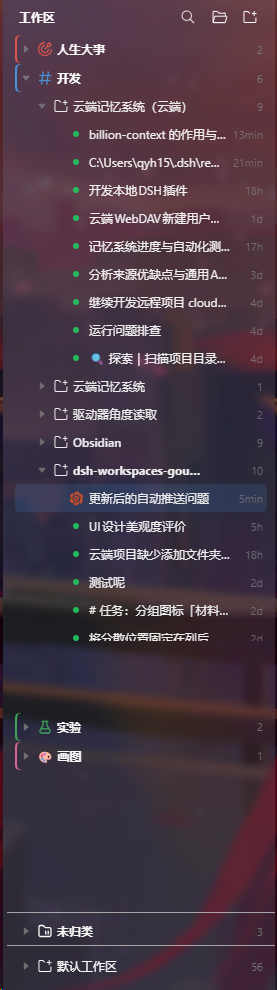
Implemented features
- Workspace groups: browse by group → project → session, with group creation, renaming, deletion, folding, and pinning.
- Drag-and-drop organization: move projects into or out of groups and reorder groups and projects.
- Group appearance: set group colors and icons, including a new Materials & Lab section for lab work, material structures, characterization, and functional devices.
- Multiple folders per project: attach extra folders, choose the default root, and place sessions under the folder that matches their working directory.
- Local and remote directories: create folders in local workspaces and registered SSH remote workspaces without falling back to a local mirror when a remote operation fails.
- Session tabs: open, switch, pin, rename, reorder, and close tabs, including closing other tabs or tabs to the right.
- Sidebar refinements: keep the default workspace pinned at the bottom, align row metadata and actions consistently, and scroll long appearance dialogs.
- Search and persistence: search sessions without losing their group context and keep groups, ordering, tabs, and folder settings across refreshes and restarts.
Install
For the Desktop profile:
dsh plugin --profile desktop add github:newbieQQ/dsh-better-workspace-group
For Web, replace desktop with web. Fully restart DSH or the corresponding Web profile after installation.
Basic use
- Click New Group in the workspace header, then drag projects into it.
- Use the
⋯menu on a project or group to manage grouping, appearance, and folders. - Open Folders… on a project to attach folders or choose its default root.
For automatic grouping by path or name, see workspace-groups.example.yaml and configure ~/.dsh/workspace-groups.yaml. Manual grouping works without this file.
Uninstall
dsh plugin --profile desktop remove workspace-groups-local
Credit and license
The original project was created by zcol under the MIT License. This fork adds Materials & Lab icons, the bottom default-workspace bar, consistent row actions, remote-workspace folders, and other refinements.
Original work © 2026 zcol; modifications © 2026 newbieQQ. See LICENSE and NOTICE.md.